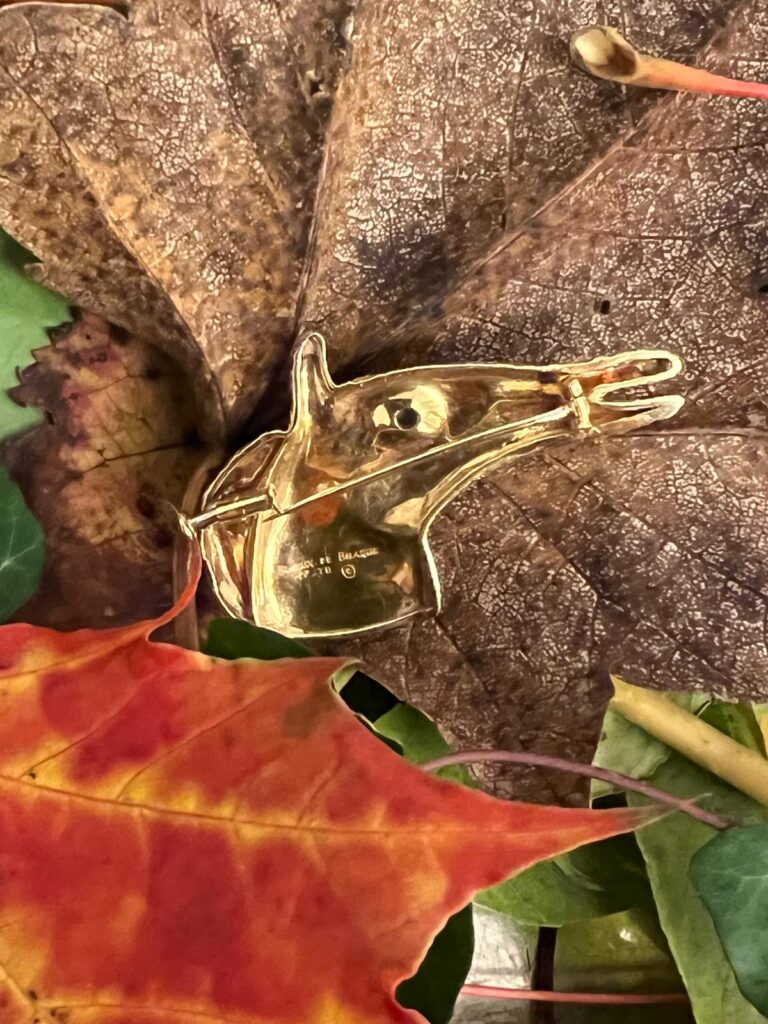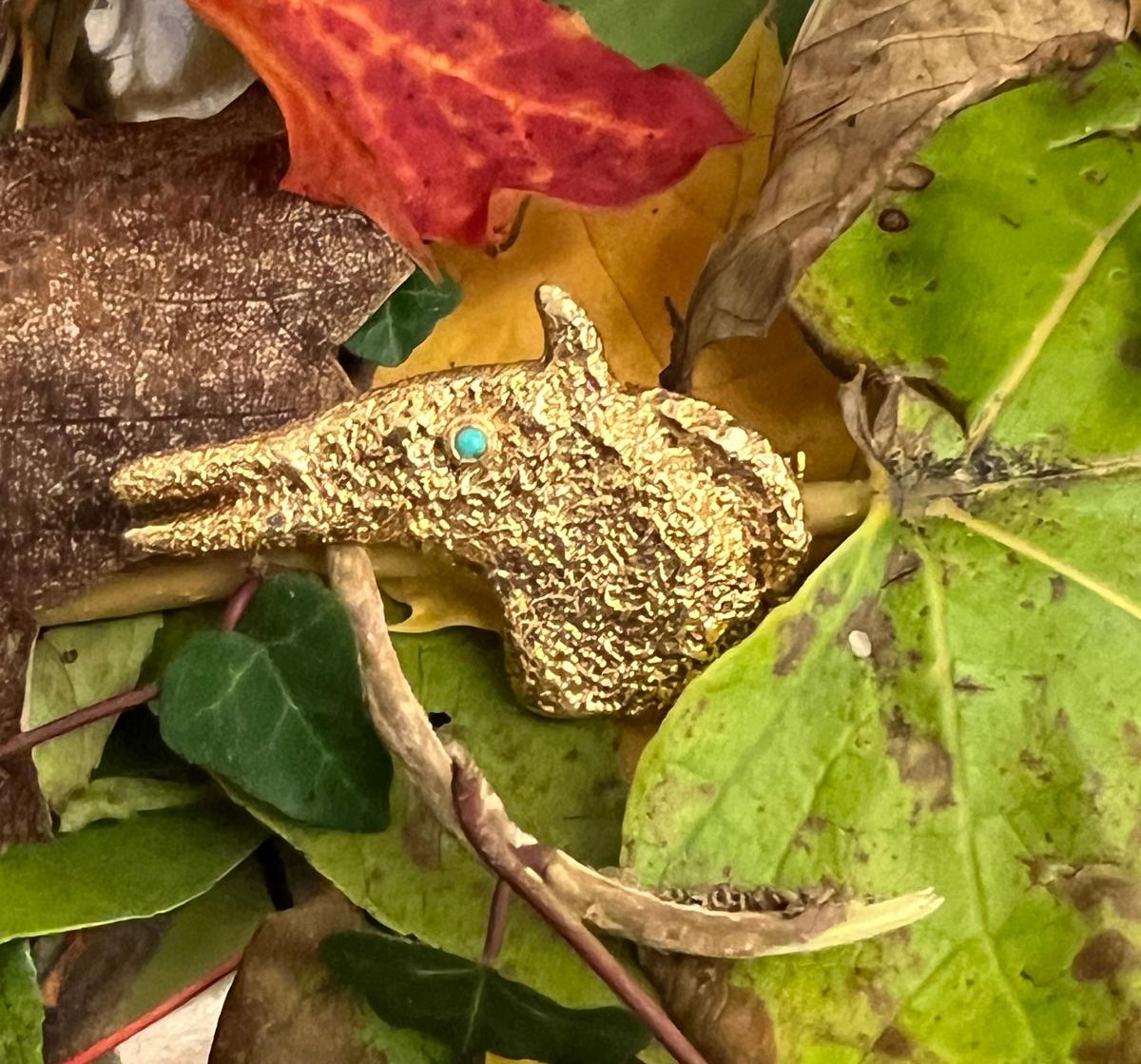

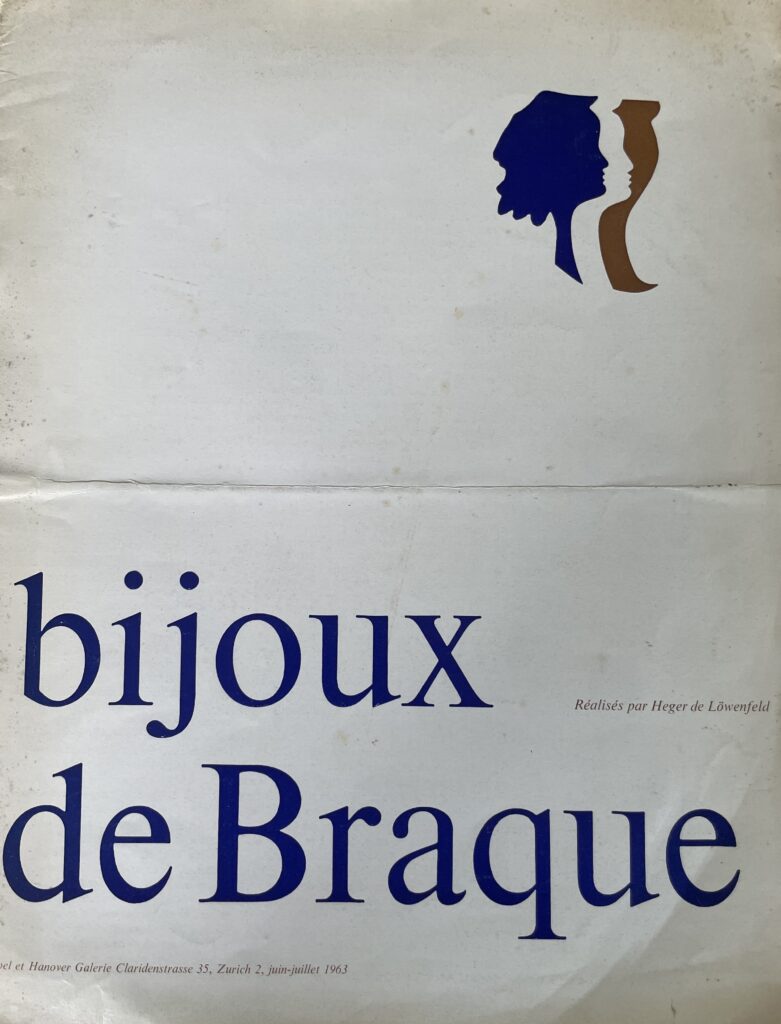
“Nothing touches people as deeply as a piece of jewelry”— said Michel Faré, the then chief curator of the Musée des Arts Décoratifs (MAD) in Paris, regarding the exhibition of George Braque’s jewellery, which was shown at Galerie Gimpel and Hanover in Zurich in 1963.
In his flowery introduction to the ‘Bijoux de Braque’ catalogue, Faré focuses more on the artist’s ideas and vision than a retrospective of his work and life, even though Braque was already 81 years old at the time.
Bijoux de Braque
George Braque (1882–1963) made a one-off foray into jewellery, resulting in a collection of around a hundred pieces. These pieces, produced in editions of 75, are now highly sought-after collector’s items. A brooch from this series is currently on sale at Galerie De Glazen Kast.
Baron and goldsmith Henri-Michel Heger de Lowenfeld
Braque, together with Picasso, was a pioneer of Cubism; he was also the founder of the so-called papiers collés. His jewellery only came into being towards the end of his life, although the seed for this was sown when his partner was given a ring as a gift. The ring was set with a cameo of a Greek god in black and white onyx. The cameo was created by the gem cutter, goldsmith and Baron Henri-Michel Heger de Lowenfeld. This craftsman would later go on to produce the jewellery collection in gold, enamel, diamonds and precious stones.
Art dealer Ambroise Vollard
To gain a better understanding of Braque’s jewellery, we must go back to the 1930s. He was introduced by the art dealer Ambroise Vollard to the philosophical works of Heraclitus of Ephesus, who lived around 500 BC on the Ionian coast of Turkey. Although little is known about this philosopher, we do know that Braque was deeply interested in his theory of opposites, unity and harmony. Heraclitus is regarded as the first philosopher to establish a connection between the physical world and the cosmos. This laid the foundation for Braque’s spiritual world. In 1932, Vollard asked him to create a number of illustrations for the publication of Hesiod’s Theogony (the origin of the Greek gods). For this, he immersed himself in the theory of mirrors and meditated on the chants of the magician and Tibetan Milarepa. And it seems that Theogonia also served as the source of inspiration for his jewellery collection, some thirty years later.
Each piece of his jewellery is a personal interpretation of the world of the Greek gods. Every piece tells a story from the realm of mythology. The brooch from the Glass Cabinet depicts a horse’s head and is titled: ‘Aréion, son of Demeter and Poseidon, comes to the aid of Adraste, who has gone to fight at Thebes’. Brooch 52 x 35 mm, gold. In other words, Aréion, the son of Demeter and Poseidon, comes to the aid of Adraste, who has set off to fight at Thebes. Brooch 52 x 35 mm, gold.
It’s also interesting to note that George Braque was the best friend of Jean Després, a silversmith and pioneer of Machine Age Jewellery. More about this artist in another article.
Please contact me for further information.